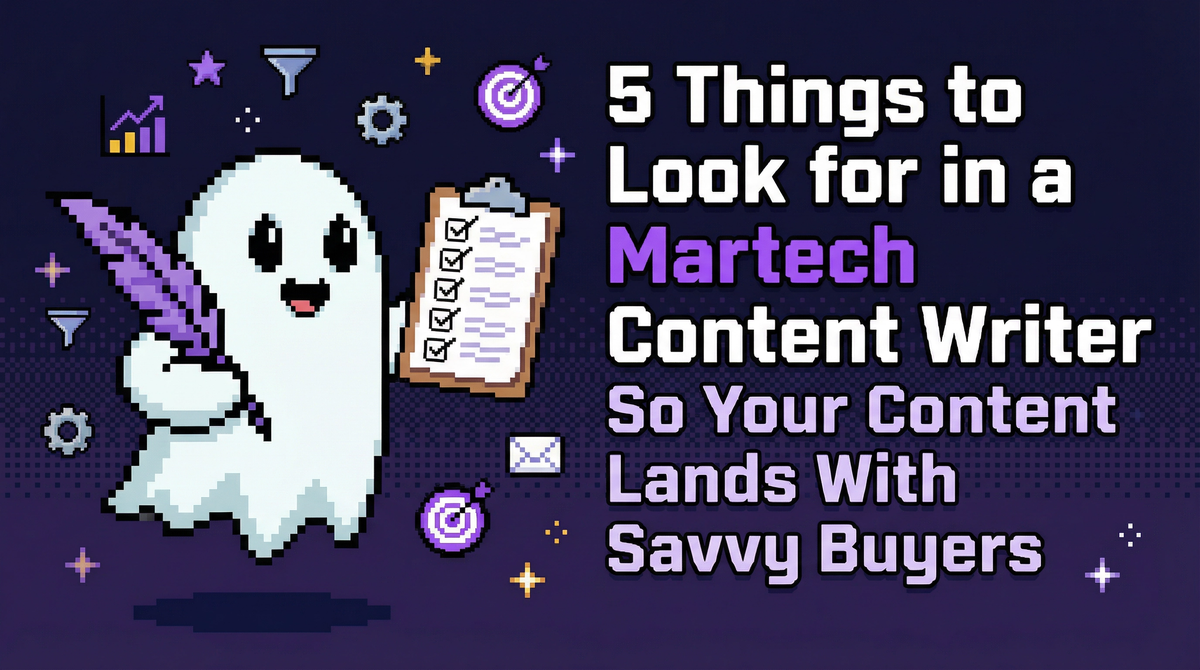
5 Things to Look for in a Martech Content Writer (So Your Content Lands With Savvy Buyers)

Martech is one of the most crowded categories in B2B software. Your buyers — CMOs, rev ops leads, marketing ops managers — are inundated with more vendor content than ever, and most of it sounds the same. Getting their attention, let alone their trust, requires content that signals you actually understand their world.
The challenge is that most teams eventually need outside help to scale, and when they do, the default choices are AI, a writer they've worked with before, or a generalist with a strong portfolio.
Each of these involves a tradeoff in quality. And by the time you realize the content isn't landing, you've already lost months of momentum and thousands of dollars.
These days, there are B2B writers who specialize in martech, and finding the right one can be a real advantage for brands trying to stand out in a crowded category.
Here are five things to look for to make sure you're hiring the right one:
1. Fluency in the martech stack
The mistake: hiring a writer who knows B2B SaaS but hasn't spent real time in martech
CDPs, MAPs, attribution tools, CMSs — a good martech writer already knows what they are, what they're for, and what makes them hard to buy, implement, and justify internally. They'll still need a briefing on your specific product and POV, but they shouldn't need a primer on the category itself.
That matters because martech buyers are not a forgiving audience. A CMO who's run demand gen programs for a decade or a rev ops lead who's rebuilt attribution models from scratch can tell immediately when a writer is working from research rather than experience. The content reads differently... it gets the terminology right but misses the subtle cues that make the problems feel real. It describes the stack without understanding why the buying decisions around it are so complicated.
2. The ability to write for the right persona at the right moment
The mistake: assuming a writer who knows B2B SaaS can figure out your specific buyers on the fly
Martech buyers aren't a monolith. A CMO evaluating a new CDP is making a different decision than a marketing ops manager trying to justify a MAP to the CFO, or a growth lead trying to figure out whether their attribution data is reliable or not. They read content differently, they care about different things, and they're at different stages of the decision.
A writer who can't make that distinction will default to writing for everyone, which usually means writing for no one in particular. The result is content that's technically accurate but doesn't connect with any specific reader's situation.
A good martech writer, when handed an assignment, already knows enough about who they're writing for to make the content land.
3. Familiarity with the use cases that actually drive buying decisions
The mistake: assuming a brief can substitute for the category experience it takes to write use cases convincingly
Lead scoring. Attribution across channels. Launching a new landing page. These aren't abstract concepts to your buyers — they're the painful everyday problems that made someone go looking for a solution in the first place.
A writer who understands these use cases can frame your product in terms and examples buyers recognize from their own work. A writer who doesn't will write around them, producing content that never makes it past the surface level or lands the specific tension the reader is experiencing. Even arming them with a strong brief can only go so far. It can tell the writer what the use cases are, but not how they actually feel to the person living them.
The test: can the writer describe a realistic scenario — a specific pain point, at a specific company stage, with a specific persona — without being handed one first?
Hiring a ghostwriter for the first time? Learn the top 5 mistakes most companies make when outsourcing content, and how to avoid them.
4. Experience at companies in your category and at your stage
The mistake: assuming enterprise martech experience translates to SMB and vice versa
Writing for a Series A martech startup is not the same as writing for Salesforce. The buyers are different, the sales cycle is different, and the content that moves deals is different. Early-stage martech buyers are skeptical in specific ways (about implementation complexity, about whether the ROI story actually holds up at their scale, about whether a smaller vendor will be around in two years, etc).
Similarly, writing for a startup that sells to billion dollar enterprises is different than writing for a startup that sells to growing D2C brands.
A writer who's worked in your category and stage knows what that skepticism sounds like and how to address it in the content. A writer who's worked across fifteen different verticals may not, even if their portfolio is impressive.
Ask about the specific companies they've written for in martech, what stage those companies were at, and what the content was actually supposed to do.
5. The ability to develop a distinct POV — not just describe a topic
The mistake: getting accurate content that says nothing your competitors aren't already saying
Martech is one of the noisiest B2B categories in SaaS. Every vendor publishes content. Most of it is decent. Almost none of it is distinct enough to stick with a buyer who reads a lot of it.
A writer who can help you say something specific — a take on where the category is going, an argument about what buyers are getting wrong, a position on a question practitioners actually argue about — is building content that earns attention and builds brand. A writer who describes topics accurately is producing content that competes with the thousand other accurate descriptions already out there.
This is the hardest thing to evaluate in a portfolio review, because a lot of generic content is well-written. The question to ask: does this piece say something you couldn't find in a dozen other places? If not, that's the ceiling you're hiring for.
Conclusion
Martech fluency at the level your buyers can detect takes time to develop: time spent reading, writing, and thinking about these problems specifically. A generalist can learn the terminology, but the use cases, personas, and category dynamics (the things your buyer is actually skeptical about) take experience to get right.
If you think this is a tall order, you’re right. Most writers won’t clear all five. But if you can find a writer in your budget that clears even three, you’ll be much happier with the output than if you’d hired a generalist.
If you're not sure where to start, the Ghostwriter Hiring Blueprint walks through the five mistakes B2B SaaS companies make when hiring a ghostwriter (including the ones that aren't obvious until after you've signed a contract).
Or if you're ready to talk through your situation, book a discovery call.